


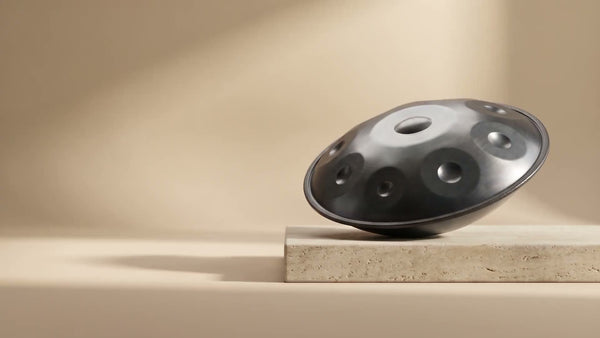
Handpan and meditation: what really happens when you play
Lunveil

You'll read everywhere that handpan and meditation go well together, but rarely why. There's nothing mystical about it: it comes down to the instrument's acoustics and how the body responds to a long, sustained sound. Here's what actually happens.

Handpan and meditation start with sustain
Strike a handpan note and it doesn't stop. It fades slowly, over five to ten seconds depending on the instrument and the material. That ring time is called sustain, and it's what sets a handpan apart from an ordinary drum. A djembe gives a short burst; a handpan gives a wash of sound. That difference shapes the whole link between handpan and meditation, because a note that lingers sets its own tempo for the player.
Why handpan and meditation slow your breathing
An instrument with a long decay won't let you rush. Strike too fast and the notes pile up into a blur, so your ear naturally pulls you back to a slower pace. In practice, most players settle into three to five strikes per breath without thinking about it. That's where the link between handpan and meditation stops being a metaphor: the instrument lengthens your breath mechanically, because playing fast sounds bad. You don't decide to slow down — the sound decides for you.
The effect is reinforced by the need to listen to the end of each note. Good handpan technique means letting your finger bounce off, then waiting. Your attention shifts to the fade rather than the next strike, which is exactly the focus exercise meditation teaches — no prior experience required.
One scale: the key to handpan and meditation
A handpan is tuned to a single scale. Every note works with every other, in any order. You literally can't play a wrong note, which is why handpan and meditation click from the very first session. On a piano or guitar, beginners hit sour notes and their attention goes to fixing the mistake. Here there's nothing to fix, so nothing breaks the flow.
The scale you choose still sets the mood of the session. A D Kurd has a minor, contemplative color — the one most people naturally associate with relaxation. Other scales sound brighter and suit rhythmic playing better. If you want an instrument specifically for relaxation, choosing the scale is your first decision, even before the number of notes.
What handpan and meditation won't do
Let's be honest about the limits. No serious study shows that a particular frequency heals anything, and many of the claims you'll see about 432 Hz rest on belief rather than measurement. What a handpan really does is produce a sound rich in overtones that holds your attention and slows your breathing. That's already a lot, and it's enough to explain why so many sound therapy practitioners use one. We cover this debate in our article on 440 Hz vs. 432 Hz.
How to set up a handpan and meditation session
You don't need much. Rest the instrument on your lap or on a tripod at a comfortable height, and play with no musical goal for ten minutes. The classic mistake is trying to build a melody: handpan and meditation work best when you let go of any intention. Strike a note, listen until it fades completely, then strike the next one. That's it.
Resting the shell on your thighs dampens part of it and shortens the sustain. For longer sessions, a tripod makes a noticeable difference by letting the instrument vibrate freely, as we explain in our guide to useful accessories. It's not a comfort accessory — it's a sound accessory.
Handpan and meditation: where to start
A D minor model with nine notes, tuned to 440 Hz, covers the vast majority of relaxation needs. Nine notes give you enough to work with without going in circles, and the striking zones are wide enough to play without aiming. You'll find these setups in our beginner selection.
To build good technique from the start, our first exercises take about fifteen minutes a day. The connection between handpan and meditation then develops on its own, without you having to chase it.