


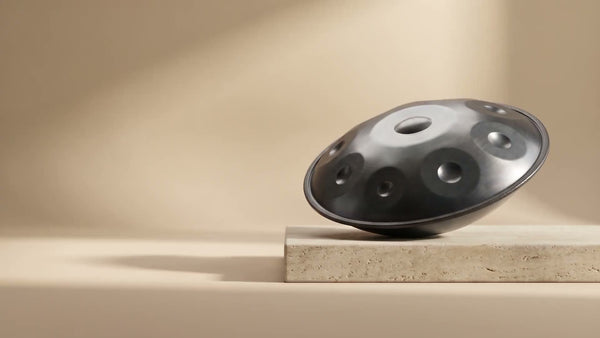
440 Hz or 432 Hz: what the reference pitch changes
Lunveil

440 Hz or 432 Hz: when you're buying a handpan, the choice of reference pitch often sparks more debate than the scale itself. Some of that debate rests on measurable facts. Some of it rests on claims nobody can verify, and it pays to set those aside. This article explains what a reference pitch is, what moving from 440 Hz to 432 Hz really changes, and how to choose based on how you play.

440 Hz or 432 Hz: what are we talking about?
The reference pitch is the frequency assigned to the A above middle C, and every other note is calculated from it. The international standard, officially adopted in 1955, sets that A at 440 hertz. It's the reference for orchestras, pianos and nearly all recorded music. Tuning to 432 Hz lowers that reference by 8 hertz, which shifts every note on the instrument down by about a third of a half step. So choosing 440 Hz or 432 Hz doesn't change the scale, the note layout or the quality of the tuning. A D Kurd is still a D Kurd, just slightly lower in the second case.
Let's get the scale of the difference right, because it's often exaggerated. 8 Hz out of 440 is a gap of about 32 cents, less than a third of a whole step. By ear, the difference between 440 Hz and 432 Hz is mostly noticeable side by side, one instrument against the other. On its own, most listeners simply hear a slightly lower sound, often described as rounder or more settled.
What the choice changes in practice
The deciding factor isn't tone. It's compatibility. A 440 Hz handpan is in tune with everything: guitar, piano, flute, recordings and other handpans. If you plan to play with other musicians, play along with songs or follow online tutorials with the instrument on your lap, 440 Hz is the sensible choice, hands down. A 432 Hz instrument will always sound out of tune next to a standard one, and a gap of a third of a half step is the most uncomfortable kind: too big to go unnoticed, too small to count as a musical interval.
432 Hz makes sense for solo playing or alongside instruments tuned the same way. Some players choose 432 over 440 for its slightly darker sound, which suits minor scales like D Kurd, or simply because they prefer it after hearing both. It's a perfectly valid aesthetic choice, as long as you make it knowingly. Our 432 Hz handpan collection lists this reference pitch clearly on every product page, with the full note layout, exactly like our 440 Hz instruments.
What frequencies can't do
You can't cover this topic without mentioning the claims floating around: a "natural" frequency, measurable healing benefits, an "original" tuning that 440 Hz supposedly replaced for shady reasons. None of these claims hold up. Historical reference pitches ranged from 400 to 460 Hz depending on the era and the city, and no serious study shows any physical effect specific to 432 Hz. Choosing between 440 Hz and 432 Hz is about compatibility and taste, not wellness. A seller who promises healing effects from a frequency is selling a pitch, not an instrument, and that's one more red flag to add to those in our guide on how to tell a truly tuned handpan.
How to choose based on how you play
It comes down to three questions. Will you play with other instruments or along with recordings? If so, go with 440 Hz, end of story. Do you only play solo, and after comparing the two, do you prefer the slightly lower sound of 432? Then 432 Hz is a sound, deliberate choice. Still on the fence without having heard both? Go with 440 Hz. It's the choice that keeps every option open, and it's the standard across our entire D Kurd handpan collection in its standard setup.
Keep in mind that the same logic applies to every tuned instrument: our D minor tongue drums also list their reference pitch. Whichever you choose, 440 Hz or 432 Hz, what matters most is that the reference pitch is spelled out on the product page. An instrument with no stated reference pitch isn't tuned to anything at all.
Key takeaways
The reference pitch is a starting point for the math, not a promise. 440 Hz keeps you compatible with the rest of the music world; 432 Hz gives a slightly lower sound for players who choose to play solo. The gap is 32 cents: audible side by side, subtle on its own, and with no proven effect beyond taste. Choose based on how you actually play, make sure the reference pitch is listed, and the rest will follow. Both options are available in our handpan collection, each with its full note layout.