


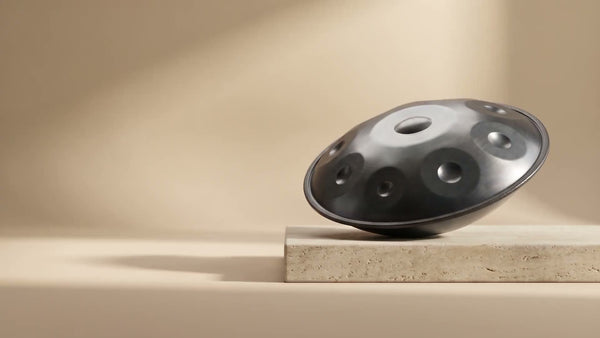
First handpan exercises: where to start
Lunveil

A handpan doesn't require music theory or prior lessons, but it does require technique. Unlike a drum, the sound doesn't come from force. It comes from how precisely you hit and how quickly your finger leaves the surface. Here are the four exercises to start with.

1. Posture before notes
Rest the instrument on your lap, tilted slightly toward you, or on a tripod at waist height. The ding (the center dome) should face you. Keep your forearms relaxed and your wrists loose: the motion comes from the wrist, not the arm.
A handpan lying flat on your lap doesn't sound as good: the bottom shell gets muffled and the sustain gets shorter. If you play often, a tripod makes a real difference to the sound.
2. The strike: bounce, don't press
Strike a note area with the pad of your finger, not the tip, and let your finger bounce off right away. The contact should last just a few milliseconds. If you leave your finger on the steel, you mute the vibration you just created.
Try the difference: strike a note and leave your finger on it, then strike again and pull away immediately. The second one rings twice as long. This is the most important skill to learn, and you can practice it on a single note.
3. Alternating hands
Play the ding with your right hand, then a nearby note with your left, alternating steadily. Count slowly to four, without trying to play fast. The goal isn't speed but even volume: both hands should play at the same intensity.
This is the exercise that turns mechanical playing into music. Your non-dominant hand will take a few sessions to catch up with the other.
4. Your first phrase
On a D Kurd scale, all the notes work together, so you can't play a wrong note. Pick three neighboring notes and play them in any order, leaving silence between them.
Silence matters as much as the notes. A handpan has a long sustain: if you fill every beat, the notes ring over each other and the result gets muddy. Play less, listen more.
How long to practice
Fifteen to twenty minutes is enough at first, every day rather than an hour on Sunday. Striking is a fine motor skill: you build it through short, regular repetition, not endurance.
Our two learning methods follow this progression in detail, with timed exercises and visual cues. They're written without music theory and delivered as PDFs.