


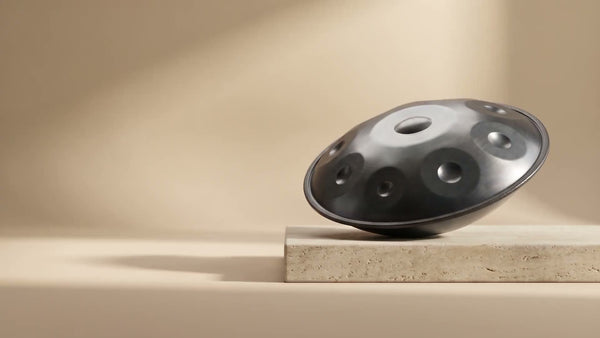
The D Kurd scale explained note by note
Lunveil

D Kurd is the most common handpan scale and the one most often recommended for beginners. Here's exactly what it contains, and why it's so forgiving.

The ding and the notes
The ding (the center dome) is a D. Around it, the notes follow a D minor scale. On a 9-note handpan, the usual layout is: D3 ding, then A3, A#3, C4, D4, E4, F4, G4 and A4.
The notes aren't arranged in scale order. They alternate left and right around the ding. This zigzag layout lets you play wide intervals without crossing your hands.
Why you can't play a wrong note
A natural minor scale has no dissonant intervals between its steps. In practice, if you strike any two notes at random, your ear hears a pleasant interval: a third, a fourth or a fifth. That's what makes improvising possible from your very first session.
It's also a limitation: D Kurd always sounds a little melancholy, because it's a minor scale. Some major scales exist, but they're rare and much harder to get into.
What the extra notes add
On a 10-note handpan, the added note is usually a C5, which extends the scale upward. On a 12-note, D5 and E5 are added as well.
These notes aren't there to help you play faster. They give a phrase room to breathe. With 9 notes, a rising melody eventually hits the top of the scale and has to come back down. With 12, it can keep going.
440 Hz or 432 Hz: the scale stays the same
The note layout is identical at both reference pitches. Only the reference changes: at 432 Hz, everything sounds slightly lower. A 432 Hz instrument doesn't play any differently, but it won't be in tune with a standard piano.
How to check a listed layout
A serious seller publishes the complete list of notes, in order. If a product page just says "D Kurd scale, 9 notes" without details, you have no way to check what you're buying, and that's exactly where untuned copies slip in.
Every Lunveil product page lists the layout note by note, for every option.