


How much does a handpan cost, and why?
Lunveil

Handpan prices often come as a surprise. They range from under $325 on some marketplaces to over $2,200 from some independent makers, a gap that seems impossible to explain for the same object. Yet it comes down to one thing: the tuning work. This article lays out honest market price ranges, what each tier actually pays for, and why a price that's too low is the biggest red flag in this market.

Handpan prices: the three market tiers
The handpan market breaks down into three zones. Below $550, be suspicious. In a market where hand tuning makes up most of the production cost, that price usually can't cover any real tuning work. Many of the objects sold in this range are stamped shells that have never been near a tuner, with notes that don't match any scale. Between $750 and $1,200, you're in serious mid-range to high-end territory: instruments tuned note by note, checked before shipping, with the scale, reference pitch and layout all listed. Above that, you're into high-end custom builds: instruments shaped entirely by hand by a named maker, where the price pays for dozens of hours of one person's work.
None of these zones is illegitimate in itself, with one exception: the first only works if the product is sold for what it is, a decorative object or a sound toy, not a tuned instrument. With a handpan priced too low, the problem isn't the price. It's the promise that comes with it.
What a handpan's price actually pays for
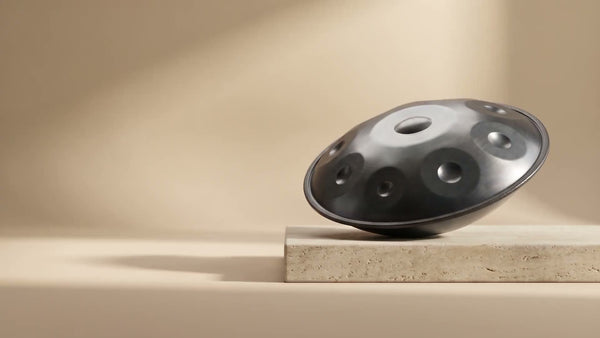
To make sense of these ranges, you need to break down how a handpan is made. First, the raw material: two steel shells, stainless or nitrided, formed and then joined. That step can be largely done by machine and is only a small part of the final cost. Next comes shaping the note domes, then the step that makes or breaks the instrument: tuning. Every note has to be adjusted with a hammer on three partials (fundamental, octave and twelfth) while keeping the whole shell balanced, because every strike on one dome affects its neighbors. That work takes hours per instrument, and no machine can do it for you.
Add to that the final check with a tuner, stabilizing the shell, sometimes heat treatment, and protective gear. That's why a handpan's price tracks so closely with how seriously it was tuned. A $1,000 instrument and a $325 copy can share the same steel and the same shape; the price difference is almost entirely the time spent turning a shell into an instrument. The number of notes matters too. Every extra dome adds tuning time, which is why a 12-note costs more than a 9-note of the same quality, as explained in our guide 9, 10 or 12 notes.
Reading a price as a consistency check
Price should never be your only criterion, either way. A price in line with the market doesn't prove the instrument is tuned: some copies are deliberately listed at $650 or $750 to look trustworthy. On the flip side, a real bargain at $450 for a new, tuned instrument practically doesn't exist. Nobody sells hours of tuning work at a loss. So always cross-check the price with the technical proof: a complete note layout, a stated reference pitch, a named material and a mention of the tuning check. Our guide on how to tell a truly tuned handpan walks through each check, with a comparison table.
How much to budget for your profile
For a first serious instrument, a realistic budget is $750 to $900. That's what our beginner handpan collection is built for: 9-note D Kurd handpans in stainless steel, tuned to 440 Hz and sold with their full note layout. The 10- and 12-note setups in our intermediate and advanced collections cost more, reflecting the extra tuning time. Also set a little aside for protection: a good padded case and a few care accessories help protect an investment at this level.
If a handpan is beyond your budget right now, the answer isn't a $325 copy that won't teach you anything and will end up in a closet. It's a tongue drum: a properly tuned instrument, in D minor like our handpans, whose laser-cut construction honestly explains its much lower price. You'll build your sense of rhythm and scale, skills that carry straight over to the handpan later, with our PDF learning methods if you'd like some guidance.
Handpan prices: key takeaways
A handpan costs the time it took to tune it. That's the key to understanding the whole market. Under $550, be extremely careful. From $750 to $1,200, you're paying for a tuned, checked instrument. Above that, you're paying for a custom build from a named workshop. At every tier, ask for the same proof: scale, layout, reference pitch and material. An honest price has nothing to hide, and that's exactly why our handpan collection shows this information on every product page.