


9, 10 or 12 notes: which handpan should you choose?
Lunveil

How many notes does a handpan really need: 9, 10 or 12? The question comes up with every first purchase, and the instinctive answer, getting as many as possible, is rarely the right one. The number of notes affects the price, how crowded the playing surface is and how much room you have to grow, but not the basic musicality. This guide compares the three formats so you can make an informed choice.

What the number of notes actually changes
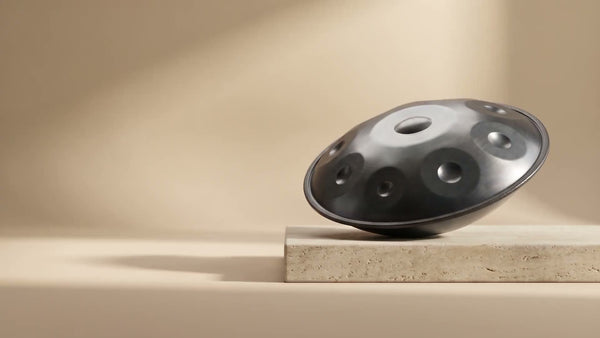
On a handpan, every note is a tuned dome that takes up physical space on the shell. Adding notes means either squeezing them closer together or placing some on the bottom of the instrument, on the side that rests on your knees. A 9-note handpan keeps wide, well-spaced playing areas that forgive imprecise strikes. At 12 notes, the domes get tighter and some move underneath the shell, so you need noticeably more precision. Knowing how many notes your hands can handle today matters more than planning for a need you might have someday.
The second effect is harmonic. All our setups share the same base: a D Kurd scale in D minor, tuned to 440 or 432 Hz, with the note layout listed on every product page. Extra notes don't add another scale. They extend the same key into the higher range or fill in the steps in between. Whatever its number of notes, a handpan stays consistent with itself. So the question isn't about being in tune; it's about how much room you have to play and how much technique you need to use it.
The 9-note handpan: the standard for getting started
The 9-note format, a center ding with eight notes around it, is the handpan's original standard, and for good reason. It gives you a full octave plus a few extra notes, enough to play the vast majority of available lessons and songs. The playing areas are wide, the layout is easy to read, and your hands find their way quickly. If you're wondering how many notes to get on your first handpan, the short answer is 9, unless you have a specific reason to go further.
That's the format we offer in our beginner handpan collection, in D Kurd with the layout D3 ding — A3, A#3, C4, D4, E4, F4, G4, A4. One more point deserves an honest mention: a 9-note handpan isn't a budget instrument you'll replace once you get good. Professional players record entire albums on this format. A 9-note can be where you end up, not just where you start.
10 or 12 notes: which player are they for?
A 10-note handpan adds one note to the ring or on the shoulder of the shell, usually in the higher range. It's only a little harder to play than a 9-note, but the extra note opens up longer melodic phrases and new resolutions in the same key. It's the heart of our intermediate handpan collection: a smart choice if you've been playing for a few months, or if you're a motivated beginner who already plays another instrument.
A 12-note handpan is a bigger step. The extra notes, often placed on the bottom of the shell, require a clear mental map of the instrument and clean strikes. They reward players who know what to do with them and get in the way of those who are just discovering the instrument. In return, the range approaches two octaves, which opens the door to rich arrangements and playing two parts at once. That's the idea behind our advanced handpan collection. So how many notes do you need to keep progressing? It depends on how much you actually play: 10 notes to build your skills, 12 to go deeper.
Number of notes and budget
The number of notes also affects the price, since every extra dome adds tuning time. Expect roughly $750 to $900 for a serious 9-note handpan, around $1,000 for a 10-note, and up to about $1,150 for a 12-note in stainless steel. You'll find the full price ranges in our guide on what a handpan costs. Above all, watch out for the opposite trap: an instrument with 12 or more notes sold for a few hundred dollars simply can't have been tuned note by note. Our guide on how to tell a truly tuned handpan gives you the full checklist.
Making the call
Here's the decision boiled down to one rule: choose the number of notes that matches how you play now, not how you picture yourself playing three years from now. A 9-note handpan to get started or for rhythm-focused playing. A 10-note after a few months of practice or if you already have a music background. A 12-note once you've actually hit the limits of your current instrument, not just in theory. Missing a note is a lot easier to live with than struggling to control your instrument.
Whatever format you choose, the signs of a serious instrument stay the same: the scale is named, the reference pitch is stated and the full note layout is on the product page. Our handpan collection shows all three formats side by side so you can compare layouts and prices, and our PDF learning methods take you from your first rhythm on 9 notes all the way to arrangements that make the most of extended setups.