


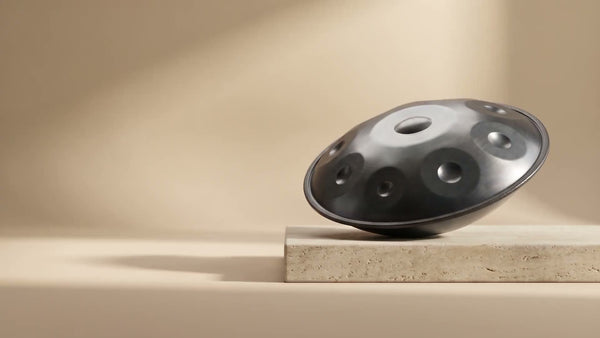
From the Hang to the handpan: the story of an instrument born in 2000
Lunveil

The history of the handpan spans just twenty-five years, making it one of the youngest musical instruments in the world. It also explains why today's market is so confusing — and why the word "handpan" exists at all. Here's the story.

The history of the handpan starts in Switzerland in 2000
It all began in a workshop in Bern that specialized in steel drums, the Caribbean instruments made from oil barrels. Its founders wanted to create an instrument you could play with bare hands, no sticks. In 2000, they unveiled a shell made of two steel half-spheres joined together, with a center note surrounded by hammered tone fields. They called it the Hang, the Bernese German word for "hand." The history of the handpan starts there, with a single maker in the entire world.
Its success quickly outgrew the workshop. Requests poured in from around the globe, far more than a small workshop could ever produce.
The shortage that shaped the history of the handpan
Faced with this demand, the workshop made an unusual choice: instead of scaling up, it cut back. Starting in 2006, buyers had to send a handwritten letter explaining why they wanted an instrument, then pick it up in person in Switzerland. Waiting lists stretched for years. This deliberate scarcity was the turning point in the history of the handpan: it created worldwide demand with no matching supply.
The resale market went wild, with instruments changing hands for several times their original price. Above all, makers around the world began building their own through reverse engineering.
How the word "handpan" was born from a "no"
The name Hang is a registered trademark reserved for the original workshop, so new makers couldn't use it. Around 2007, an American maker proposed the generic term "handpan" for this family of instruments, and the word stuck. It's one of the most misunderstood points in the history of the handpan: Hang and handpan aren't two different instruments, but a brand name and the generic name for everything that followed.
The Bern workshop stopped making the Hang in 2013 to focus on other designs. By then, dozens of independent makers were already in business.
What the history of the handpan tells us about today's market
An instrument born twenty-five years ago has no conservatory tradition, no industry standard, and no certification body. Anyone can sell a steel shell and call it a handpan. That's a direct result of this fast-tracked history of the handpan, and it explains why instruments tuned by hand over dozens of hours now sit alongside press-formed decorative shells.
It's also why knowing what to check matters so much when you buy — a topic we cover in how to tell if a handpan is really in tune.
Why the history of the handpan affects prices
Handpans aren't mass-produced, and that hasn't changed since 2000. Each note is hammered, then refined by ear, step by step — many hours of work per instrument. No machine has replaced that skill. Understanding the history of the handpan means understanding why a serious instrument costs about as much as a good student violin, a topic we cover in what the price pays for.
A growing family
Alongside handpans came tongue drums, whose tongues are cut rather than hammered. Simpler to produce and therefore far more affordable, they're now the natural stepping stone to the handpan. They belong to the same family of melodic steel percussion without the same manufacturing complexity, as we explain in handpan or tongue drum.
Twenty-five years after the Bern workshop, the instrument has spread to every continent without ever becoming an industrial product. That's what gives it its value — and what makes it commercially fragile. Our models, with the note layout and reference pitch listed for each one, are in our handpan selection.