


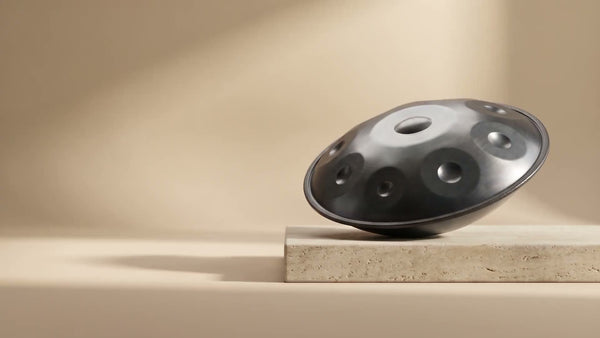
How to transport a handpan without damaging it
Lunveil

Impacts and temperature swings are the two real reasons a handpan goes out of tune, and travel exposes it to both. Here's how to move your handpan without losing its tuning.

Always flat, never on its edge
A handpan standing on its edge puts all its weight on a small section of the rim — the thinnest part of the instrument and the hardest to repair. Carry it flat, in its case, and never set anything on top of it.
In the trunk of a car, wedge it in so it can't slide when you brake. An instrument that slides a foot (30 cm) and hits the side of the trunk takes a hard enough knock to deform a tone field.
Temperature: the hidden danger
This is the most underestimated factor. A car trunk in direct sun easily tops 140°F (60°C) in summer and drops below freezing in winter. Steel expands and contracts, and the tone fields — which hold their pitch through precise tension — shift.
The rule is simple: never leave a handpan in a parked car. When you arrive, leave it in its case for thirty minutes before playing so it can come back to room temperature. Playing an ice-cold instrument won't damage it, but it will sound out of tune.
On the train or bus
A case with backpack straps goes on your back and fits anywhere. Avoid overhead racks, where the instrument can fall during sudden braking: keep it at your feet or between your knees.
Flying: never as checked baggage
The cargo hold combines every risk: rough handling, freezing temperatures, and pressure changes. A handpan rarely comes out of it undamaged.
In the cabin, a handpan measuring 20.9 in (53 cm) across is larger than standard carry-on limits. Contact the airline before you fly: some allow musical instruments in the cabin on request, while others require you to buy an extra seat.
After the trip: the three-note check
Strike the ding, then two notes on opposite sides. If the sound is clean, with no beating or stray buzz, the instrument is fine. A beat — that steady pulsing in a sustained note — means a tone field has shifted.
If that happens, don't try to fix it yourself: retuning a handpan takes specialized tools and a trained ear. Contact us and we'll point you in the right direction.